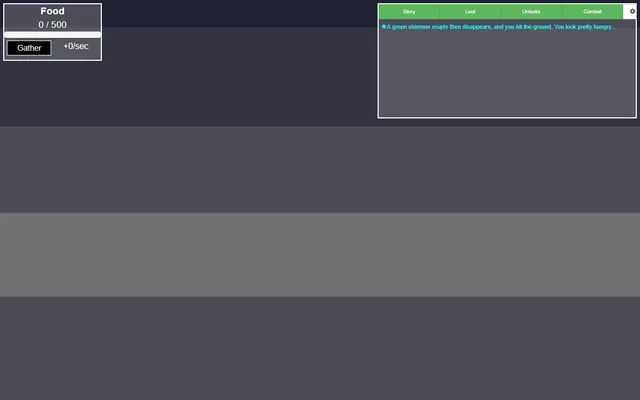
A text based incremental is one whose interface is words, numbers and buttons, with no sprites and usually no art at all. The whole game is a list you read. That sounds like a limitation and is closer to a specialisation, because what an incremental asks of you is comparing numbers and deciding which to grow next, and a list is the best instrument ever built for that.
It matters that this is a choice rather than a budget. Plenty of games look plain because nobody drew anything. The ones here look plain because a drawn version would be worse: the screen would go on a picture of a village instead of the eleven figures you need visible at once to decide.
What is here
Shortest and gentlest first, densest last.
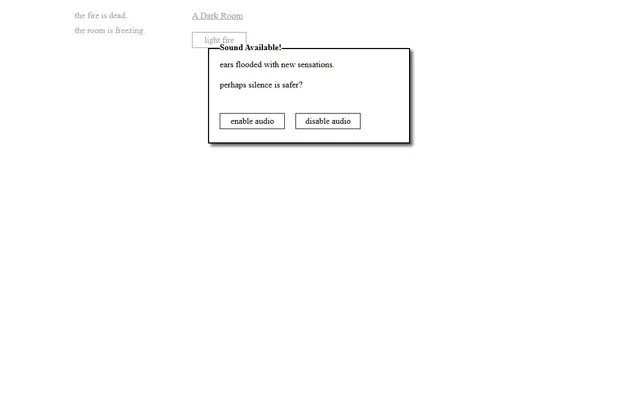
A Dark Room is the one people mean when they say the format can carry a whole game. It opens with two lines of text and a single button and it keeps changing what kind of game it is for about three hours. The plainness is the delivery mechanism, because a screen with nothing on it can grow a control you did not know existed and you will notice. It has no prestige reset and it finishes, which makes it the shortest and the best introduction.
Universal Paperclips is the shortest thing here and the one that most obviously could not have been drawn. It is buttons, a wire count and a price, and the argument it is making is that a system optimising a goal will keep optimising it past the point where anyone wanted it to. Art would have to depict something, and the moment it depicts something the game becomes about that thing instead of about the number. It runs about three hours, it ends, and the interface changes shape underneath you several times on the way, each change a new row appearing rather than a new screen. Frank Lantz made it and it is free in the browser.
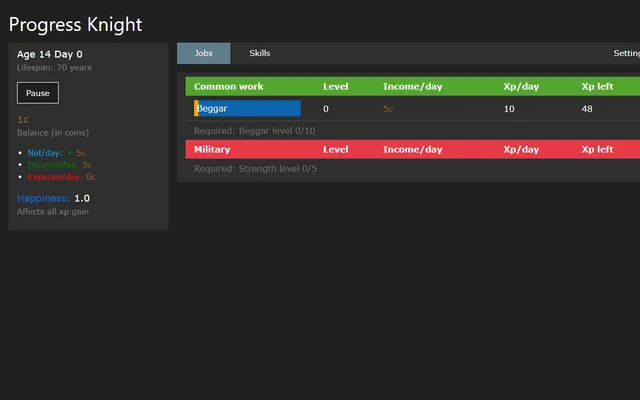
Progress Knight is the opposite use of the same format: no mystery at all, everything visible from the first screen. It is a medieval career ladder made of progress bars. You beg, you get a job, you age, you die at seventy, you rebirth with permanent experience multipliers. Every job and skill is on one page with its own bar, and the game is the arithmetic of which bar to feed. It runs only while the tab is open.
Swarm Simulator is the purest example of the format on this page and the easiest to read. Three columns, no pictures, a buy button and a box you type a quantity into. Drones eat meat, meat buys drones, then a queen produces drones, a nest produces queens, and the chain keeps going for eleven tiers to overminds. Because everything is a plain column of text it is also the one that survives a phone best, which is unusual company for a game this dense. The joke is the escalation: the sentences describing your swarm eating never change tone while the numbers acquire suffixes you have not seen before.
Kittens Game is the largest and the least forgiving. It is a village of cats that can genuinely starve, presented as tabs of resource rows that keep multiplying for weeks. It is closer to a spreadsheet than to a story and does not apologise for it. Come here if the list is the part you liked.
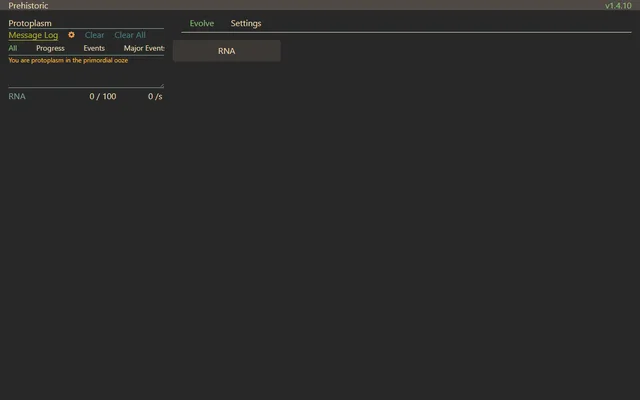
Evolve Idle is Kittens Game's problem at civilisation scale. You start as protoplasm, click through the tree of life, and commit to a genus and a species out of roughly sixty, each with traits that reshape your economy for days: a photosynthesising race has a different food problem from a carnivorous one, small races need less housing and produce less, and some cannot use certain buildings at all. Then it becomes a civilisation builder rendered entirely as tabs and rows, from stone tools through government types and industry to orbit, with a research tab you cannot read in one screen. It also has the best answer here to the tedium the format invites, since both the building queue and the research queue can be filled and left alone.
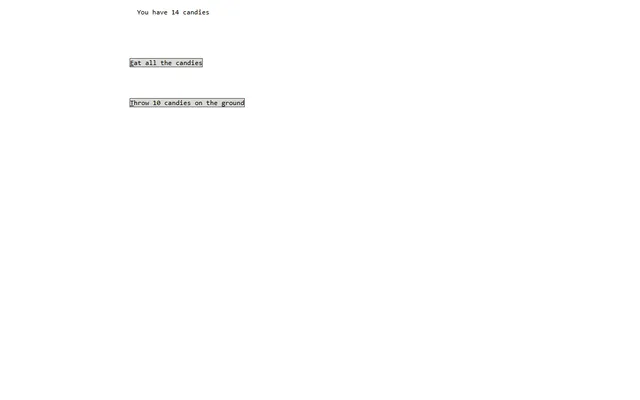
Candy Box 2 abuses the format on purpose. It starts as a candy counter on an empty page and becomes an ASCII role-playing game with quests, gear and a lollipop farm, drawn out of punctuation. It is the strongest argument here that text is a medium rather than a shortfall, and it is also the one people bounce off, because it expects experimentation and will let you waste resources learning that.
Trimps is the densest thing in the catalogue. Rows of numbers, four stacked reset layers, and a first portal a few hours in that resets everything you built. It is desktop only, and not out of laziness: the layout assumes a wide window full of figures and a phone cannot show enough of them at once to play from.
What separates the good ones
Two things, and neither is the writing.
The first is whether the text is doing work the layout could not. A Dark Room's sentences carry the setting because there is no picture to carry it, and the game would be smaller with art rather than larger. Compare that against a game that is text-only until the developer commissions a tileset, at which point nothing about the systems changes. If the plainness can be removed without loss, it was never load-bearing.
The second is information density, the one advantage the format has. A text incremental that hides half its numbers behind a menu has thrown that away. Kittens Game and Trimps both put everything on screen at once and trust you to cope, which is why they are hard to look at for ten minutes and why people stay for years. Density is not the same thing as clutter, though, and Swarm Simulator is the proof: three columns of plain rows, everything visible, and legible enough that it works on a phone Trimps refuses to run on.
One thing that is not on the list: brevity. Text games are assumed to be short games, and the long entries here run to months. The format says nothing about length, and this page holds two three hour games that end and one with no ending at all.
If you are here because of A Dark Room, and what you want is another game that hides its own shape from you, that is a narrower question with its own guide. This page is about the format. That one is about the trick.