What kind of game this is
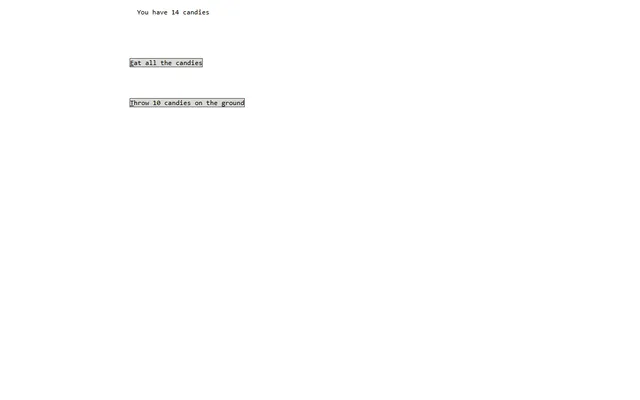
Candy Box 2 opens with a number and a box. You have some candies, they arrive at one per second, and there is a button to eat them or throw them away. That is the whole game for the first minute, and it is deliberately stupid, because aniwey is setting up a joke about people who will sit and watch a counter.
The joke is a cover. Underneath it is a proper role-playing game with an inventory, a forge, an equipment table, a world map, spells, quests with real failure states, and bosses that will kill you repeatedly until you go away and come back better equipped. It was released on 24 October 2013, a sequel to Candy Box from earlier the same year, and it is still up and still free.
The candy counter, and what it is for
Candy accumulates while the page is open, at one per second to start with. There is no offline progress and nothing happens while the tab is shut, so the counter is a real reason to leave the game running in a background window, which is the oldest trick in this genre and here it is the entire economy.
Candy buys equipment and consumables. The first real purchase is usually a wooden sword, and from there the shop, the forge and the merchants take everything you have. Money in this game is a food and it is spent on violence, which is the sort of thing Candy Box 2 does without ever pointing at it.
The ASCII art
Every location, every enemy and every screen is drawn in text characters, and it is done well enough that people remember specific images from it years later. It is not a stylistic apology for missing art. The map is a grid of symbols you walk across, combat is a side-on strip of characters where your little figure and the enemy's throw projectiles at each other in real time, and the whole thing reads clearly at a glance.
The art was drawn fresh for the sequel rather than carried over from the first game. Presentation this plain also means the game loads instantly and runs on anything.
Quests, gear and the real RPG underneath
Quests are separate scenes you enter from the map. You bring your equipment, your health bar, and whatever consumables you loaded, and you either finish or you die and lose the attempt. Combat is not turn-based and it is not idle: you move, you dodge, you time an attack, and the pink and red gloves that heal or throw fireballs are cast by pressing a key while things are happening.
The equipment layer is where the depth is. Weapons have real stat differences rather than a single damage number that goes up, armour trades speed for protection, and several items exist only through the forge or through enchanting at the wishing well. Some of the best items in the game are hidden behind puzzles that are not signposted anywhere, and the community wikis exist because of that rather than because the systems are complicated.
Bosses are the wall. Several of them expect a specific piece of equipment or a specific tactic, and grinding candy will not substitute for either.
The lollipop farm
The lollipop farm is the second economy and the one that most defines the late game. You plant lollipops, planted lollipops grow more lollipops, and the growth rate rises with the number planted until it flattens out at a hundred a second from planting alone. Three separate items multiply that, and stacking all of them takes production into the thousands per second.
Once you hold ten thousand lollipops you can build a mill, and feeding the mill converts lollipops back into candy. Once you hold a hundred thousand you can dig a pond and buy lolligators, which run the conversion the other way. So the two currencies feed each other, and the mid game becomes a question of which direction you need to push today. It is a genuinely good economy design sitting inside a game whose opening screen is a joke about a box of sweets.
Controls, and the phone question
Tabs across the top, buttons underneath, and a set of keyboard shortcuts for switching tabs and for casting during quests. You need a keyboard to play the combat properly.
aniwey did try to make it work at low resolutions and on touchscreens, and it is playable that way, but a computer is clearly the better place for it. Saves are held in your browser, and the game gives you a save string you can copy out. Do that before you clear anything.
How long it takes
The twelve hours in this page's data is the figure walkthrough sites give for a full playthrough with the tab left open, which matches what the endgame bosses demand in accumulated resources. Following a guide it can be done in a few evenings. The recorded speedrun is under fifteen minutes, which tells you how much of the twelve hours is waiting rather than playing.
Who made it, and where to play
Candy Box 2 is by aniwey, named in the source licence notice as David L., who was a French teenager when he wrote the first Candy Box in April 2013. Cookie Clicker's Orteil has cited that first game as an inspiration, which makes aniwey one of the load-bearing names in this genre despite having made two games.
Play it free at candybox2.github.io. The source is on GitHub at candybox2/candybox2.github.io under GPLv3, with an additional permission under section 7 that allows serving the minified code as long as the licence notice and a link to the corresponding source travel with it.
The copy in the frame above is one we compiled from that source ourselves, using aniwey's own build steps, and serve from our servers. It is not the official version and we are not the publisher. GPLv3 is a strong copyleft licence, so the source of this exact build with our changes in it is downloadable from us at /play/candy-box-2/source.zip, and the licence page lists the changes and reproduces the notice. Saves here are separate from saves on aniwey's site, so if you have a run going there, use the save string to bring it over, and use aniwey's site if you would rather play the developer's own build.