What kind of game this is
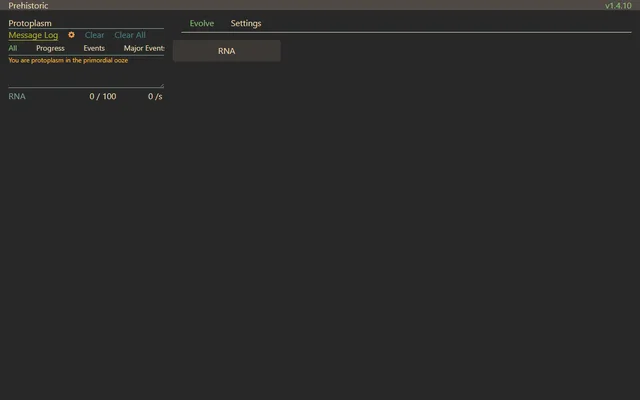
Evolve opens with almost nothing: a puddle of protoplasm and a button. You spend a few minutes clicking through the tree of life, choosing a branch at each fork, until you have committed to a genus and then to a species inside it. That choice is the whole game's opening move, because every species carries traits that change your economy for the next several days of play.
Then the game becomes a civilisation builder rendered entirely as tabs, lists and numbers. You gather stone and lumber, discover fire, learn agriculture, build huts, assign citizens to jobs, argue with a government type, industrialise, and eventually put things into orbit. There is no map and no art beyond icons. Everything is a row of text with a cost beside it, and the interest comes from the fact that the rows keep multiplying: by the mid game you have a resource list that scrolls, a research tab you cannot read in one screen, and half a dozen production chains quietly starving each other.
The species, and why they matter
There are roughly sixty playable species spread across genus groups: humanoid, carnivore, herbivore, small, giant, reptilian, avian, insectoid, plant, fungi, aquatic, fey, demonic, angelic, synthetic, eldritch and more. They are not skins. A species that eats meat has a different food economy from one that photosynthesises. Small races need less housing and produce less. Some cannot use certain buildings at all.
The genus you pick also grants a shared bonus that persists for the run, so the practical unit of choice is genus first, species second. Most of the replay value in Evolve is here. A run as a plant is a genuinely different set of problems from a run as a demon, and the game expects you to work that out yourself rather than telling you.
Resets, which is where it gets serious
Evolve does not have one prestige layer. It has a menu of them, and each is a different ending you build towards.
The first is Mutual Assured Destruction, unlocked just before the space era, which blows up the planet and pays Plasmids scaled to your population and the knowledge you spent. The in-game wiki recommends taking it as soon as you can on a first playthrough, and that is good advice: it is the cheapest way to see the whole loop.
After that the list opens up. Bioseed requires building and launching a seeding ship, pays Plasmids and Phage, and lets you change what planet you live on next run. Beyond those sit Black Hole, Vacuum Collapse, Ascension, Cataclysm, Terraforming, Demonic Infusion, Apotheosis, AI Apocalypse, Matrix, Retirement and Garden of Eden, each with its own entry requirements and its own currency. Plasmids, Phage, Dark Energy, Harmony Crystals, AI Cores, Blood Stones, Artifacts, Soul Gems and Supercoiled Plasmids are all separate stockpiles doing separate jobs.
The effect is that Evolve stops being a game with a reset button and becomes a game about choosing which reset you are aiming at this month, since the route to a Black Hole and the route to Ascension diverge hundreds of hours before the end.
The offline question
Evolve does not simulate offline production, and it is honest about it. The game's own FAQ answer to whether you can play offline is no, but that once the page has loaded it keeps working without an internet connection until you refresh.
What it has instead is Accelerated Time. Pause the game or close the window and you bank one minute of accelerated time for every minute and a half stopped, up to a cap. When you come back, the game runs at double speed until that bank is spent. It is a fair compromise, and it is not the same thing as coming back to a full day of production, so treat Evolve as a game you leave running in a tab.
Controls, and the phone question
Everything is clicking rows. The interface is dense but it is responsive: the page ships a viewport meta tag and the stylesheet has breakpoints down to around 512 pixels, so a phone gets a stacked layout rather than a shrunken desktop one. It is still a lot of small numbers in narrow columns. Usable on a phone, unpleasant as a main home.
The game has a built in wiki, reachable from the interface, which is unusually good and is where the reset explanations above come from.
How long it takes
There is no ending. The five hundred hours in this page's data is our judgement of what a serious first pass through several reset types looks like, not a measured average, and we found no HowLongToBeat entry for it. A first MAD reset is an evening or two. Everything after that is measured in months.
Getting further
Take MAD the moment it appears. New players stall for hours trying to squeeze more out of a first run that is worth very little.
Read the species traits before you commit at the evolution stage. You cannot change your mind afterwards.
Use the queues. Both the building queue and the research queue can be filled and left alone, and they are most of what makes the game idle rather than a clicking chore.
Who made it, and where to play
Evolve is by pmotschmann, who has been developing it in the open for years and was still pushing commits this month. Play it free at pmotschmann.github.io/Evolve.
The source is on GitHub under the Mozilla Public Licence 2.0, which is a real licence to redistribute, unlike most of the games on this site. We are not hosting a copy yet because Evolve is compiled rather than shipped as plain files, and we do not put a build in front of readers until we have made and checked it ourselves. If you want the same shape with less to read, Kittens Game is the gentler version of this idea.